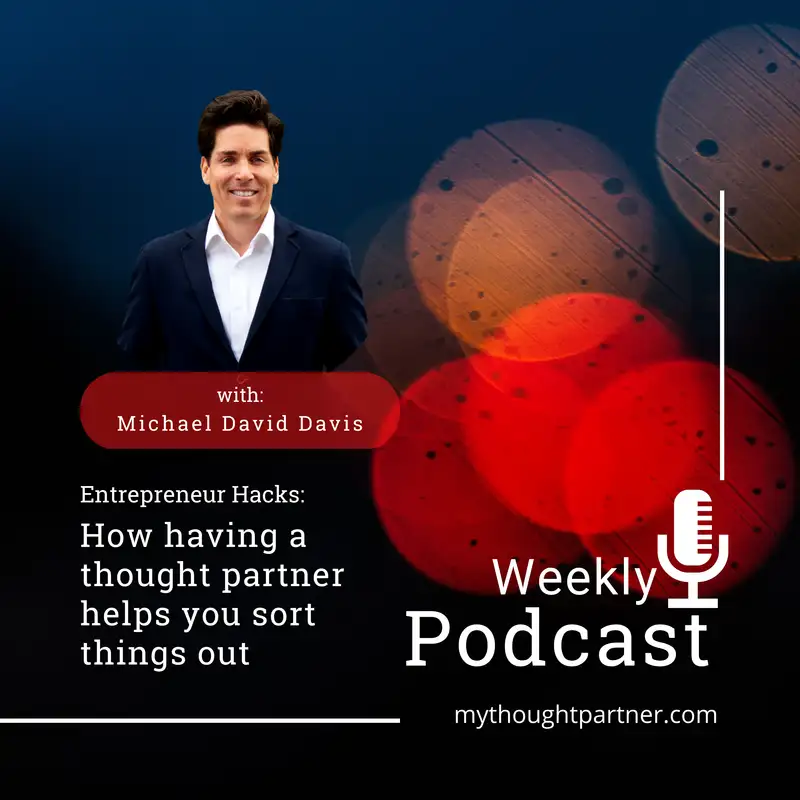
Michael: Hi, I'm Michael David Davis.
Nicole: And I'm Nicole Davis.
Michael: And we are your thought partners.
Nicole: Were you actually okay with the way I said my name? I feel like every time I say my name, you're like, "With more gusto."
Michael: With more gusto? What's that?
Nicole: With more gusto. Oh, more gusto.
Michael: I mean, look, I'm just letting you live your life. Thank you. We're going to be talking about, in this episode, the ability to eliminate distractions and streamlining that process.
Nicole: I love it. This is my love language.
Michael: She loves streamlining everything to make the process more efficient, and of course, time blocking. But really, those distractions, eliminating them, I think, are probably the most important things, for sure. Believe it or not, it's painful to do these episodes and put the phone on Do Not Disturb, and I think that is so challenging because, as you mentioned before, it's the...
Nicole: Oh, my gosh. The pings and the... It's the potential of missed opportunity, right? Or missed efficiency, missed follow-up. Like, what am I going to miss by putting my phone on Do Not Disturb for the next 40 minutes or whatever it is? Who might be disappointed in my lack of immediate response?
Michael: She has a huge amount of FOMO. She's like the FOMO queen right here. If somebody says they're doing it and she found out after the fact, it will be my fault that it got missed.
But I think, ultimately, that's probably the most simple thing to talk about. But before we get into even removing the distractions that are around you, I think probably removing the distractions that are actually in our workspace, right? Because, you know, this is all about changing your mindset. And I think when you are getting into an environment where you're sitting down, and if we're trying to actually make these changes to become more efficient with ourselves, right? I don't want to go back and sit at my workspace and it's just cluttered and messy. There's paper stacked up. I have pens or pencils or my keyboard and my mouse and all these chargers or any of that.
Nicole: I mean, okay, so for you, that does not bring peace, right?
Michael: No. I'm like, I want three items on my desk.
Nicole: Yeah, yeah, yeah. But let's be clear, for other people, that does bring peace. So I don't want to make it like you have to have a spotless desk if you want to have a great workday. I think, as we've said before, it's about finding what works for you, but it's being realistic about what works for you. Because I would tend to agree. For myself, I get anxious when I have too much stuff in my workspace.
And so I do these periodic purges where it's like, let me get rid of all these Post-it notes that are sitting on my monitor. Let me, you know, clear off these—I really like a paper calendar of to-do lists. And so sometimes I'll keep them for a couple weeks just to make sure that I don't forget if I need—whatever.
Michael: Can I pause you, though?
Nicole: Yeah.
Michael: You mentioned something that's a little shocking to me, so...
Nicole: Great.
Michael: Yeah, right. But it also kind of goes into what we're talking about with efficiencies, right? You mentioned having Post-it notes around your monitor. So can you tell us more? I'm very curious. I mean, I've seen it. I just thought you like putting little color-coded things around your monitor because...
Nicole: It depends what it is.
Michael: It gives you a little more flair.
Nicole: It's not decorative.
Michael: Yeah, I see. Whenever I walk by your office, I'm like, oh, look, she's got—like, this is a yellow day, or this is an orange day. So why do you have those Post-it notes on your monitor?
Nicole: Okay. I mean, for starters, I think because I started off as a teacher, and that's a staple. When you graduate with your education degree, they're like, "And here's your obligatory stack of Post-it notes." I don't know.
Michael: So tens of thousands of dollars, and they give you a stack of Post-it notes.
Nicole: Amen. So, you know, by the way, shout out to 3M, but they have to be the super sticky Post-its. You don't want that garbage Post-it business. And you don't want—no offense to anyone—you don't want an off-brand Post-it. You need a super sticky 3M Post-it.
But I don't know. I think it helps me focus. I use them for various reasons, right? Sometimes I'll use them in design sessions with clients or partners to kind of help brainstorm. And for me, that's an easier way to brainstorm, right? They're mobile. I know we're not getting into tools yet. It's going to be really hard for me. But, you know, there are also tools like Miro or Mural that can replicate, in a digital format, kind of having that design session and the Post-it world.
But I don't know. It just depends on how I'm feeling that particular week. Sometimes it's easier for me if I have a lot going on. I like to steer into the skid. So when I'm really stressed, I kind of throw myself into it more to make sure that I'm not missing anything. So sometimes having Post-its of all those little things that need to get done, then I can kind of take them off my monitor, ball them up, throw them away.
Michael: So how does... I guess, to me...
Nicole: I feel like you're judging me.
Michael: I'm always judging.
Nicole: Okay, great.
Michael: Secretly, deep inside, I'm judging you.
Nicole: Awesome. So healthy.
Michael: But to me, I'm thinking about, I guess, because, again, this is what gives me the anxiety. If I'm going to my desk and I see these plethora of Post-it notes, even if they're neatly placed around, you know, the rim of my monitor, that's giving me so much anxiety knowing, oh my gosh, I need to get these down. I haven't done those.
Like you said, we're not talking about tools, but to me, the technology aspect of it, where if it's not on my monitor, but there's something that's on my screen maybe that can get it done, or like you mentioned in the past, having your tasks to check off. So how do you—is there a determination scale that you have that takes you from using something with such an actual tactile response versus what you do? Or do you write it down and then you add it into a digital format?
Nicole: Honest to goodness, I think that I kind of mix up my organizational structure from time to time just to keep myself engaged and interested. I try out a lot of different things. I read a lot about what other people are doing, or listen to podcasts like this to figure out what other folks are doing and what's helpful for them, and I try those things out. I think we're always a work in progress, and I'm not there yet, right? So for me, I do like to try a bunch of stuff out.
You know, the other thing with the Post-its, and this has suddenly become an infomercial, but the other thing with the Post-its is that sometimes when I'm in a meeting and I have really clear points that I want to make sure I hit, sometimes having those, like, okay, Nicole, you've got five points, and here's one, two, three, four, five Post-its. And just having them up on my screen, I don't have to worry about doing the wrong screen share where you have your notes app up and everyone sees what you were writing to yourself. I don't know.
Michael: So this is while you're on a Zoom call, or this is while you're on something. So what I'm doing is, in calls with clients, I'm trying to look at the camera so that they know I'm looking at them, but, you know, I also want to watch their reactions. So I'm imagining you have five Post-its. And so instead of seeing—if we're on a Zoom call, you're basically putting a Post-it over my face and not looking at me.
Nicole: I feel targeted right now.
Michael: I guess. No, it's just more about understanding, right? Because I think that is a pretty cool...
Nicole: I think it just depends. It's not all the time, right? But I mean, I feel like I put it close enough to the camera so that I can still... I mean, that's why I put it there, right? So I can still make close enough eye contact. I can slyly get rid of it once I'm done with that one. I don't know. It just kind of depends.
I mean, the other thing, too, is that I do laugh a lot, and I'm a loud laugher. And I've noticed that sometimes if I have notes on my desk, I'll laugh and blow them off the desk.
Michael: Yeah. Wow.
Nicole: So I need a little adhesive to help me out, okay? All right.
Michael: Look, but I think that is a really valid point on just the organization side, or even the decluttering. So instead of having maybe two or three notepads, or where you wrote your notes on, this sounds like it's a nice temporary way that once you're finished...
Nicole: It's a supplement.
Michael: You can just pull it down, and then it's a clean space.
Nicole: Look, it's not a system. It's a supplement, right? And I'm so shocked that we went down this road, but the whole purpose of saying that was that it doesn't have to look like what you think it should look like. It doesn't have to look like, you know, Marie Kondo just rolled through your office and organized everything and threw out everything that doesn't spark joy for you, yeah? I just think different things work for different people. And some people thrive in stuff. Stuff brings some people a lot of comfort. And so just having those things around you can kind of, you know...
Michael: I think they call those people hoarders.
Nicole: No. No.
Michael: Okay. No. Fair enough.
Nicole: But, you know, sometimes there are just things that have that emotional energy or are calming for you or whatever. And so this is, like, a 10-minute segment on "you don't have to have a clean desk to be organized."
Michael: Look, but I think it's great because, again, I love having that clean space to go to, right? And again, you know, you are very different than I am. But as you mentioned, I think it's okay for people to realize. Because if it was my way, I would be going to people's desks and saying, let's clean this. I feel like, you know, there's some weird maybe teacher that made me have to clean up behind myself all the time. And so that gives me anxiety.
But for you, and I'm sure most everyone else that's out there, they also have that feeling of, you know, you might have a picture of your pet or your family member or your partner, just somebody that gives you that comfort sitting down. But I just feel like those get lost in the other clutter that's around because you're piling other things around it, right? So that's a good happy medium, I think, that you have the ability to do that. Yeah. I mean, that's cool.
Nicole: Okay, great.
Michael: So outside of our desk area, then, what else can we declutter? Does it matter?
Nicole: I feel like I'm going to just uncover all the ways that I'm still analog and not digital here. But I mean, the other thing that I do, I love a good notebook. And I have, you know, kind of a labeling system. So there's an organizational system within the notebook. But sometimes, for me, it is just really helpful for my own retention of information when I'm sitting in a meeting to record things down on paper and in a notebook.
Sometimes it's more distracting, especially if you're on Zoom or something like that, to sit there clacking away, or have to keep muting and unmuting every time that you're trying to do your good active listening noises with your client, right?
So I do like to keep a notebook. But then I also like to keep those notebooks, which is a little kooky. So I have started a system where I have all my filled notebooks separately. So if I need to reference them, they're there. But they're all kind of facing one direction. And then, if I do go back and need to reference something in that notebook, I flip it around the opposite way. So it's kind of like, they talk about this when you're decluttering your closet, right? To flip your hanger backwards.
Michael: I was just going to say, you should see the closet. It's flipped. And I'm like, why are these clothes all backwards? And that's how you know.
Nicole: Well, so you flip the hanger backwards once you've worn it, so that you can kind of visually see things that you've worn. And so you can also visually see things that you maybe haven't worn in three months, six months, whatever, and know things that you may want to start thinking about getting rid of.
Anyway, so I do that with my old work notebooks, my filled notebooks, so that after six months, I can look and say, okay, you didn't use one thing in that notebook in the last six months. So look through it. Do you still need it? And, you know, if I feel like I still need it, I still need it, okay? And I'll hang on to it. But if not, then it's something that can go in the recycling bin or whatever. So that, for me, has been kind of a helpful way to have a bit of that analog piece, but also declutter and keep things a little bit more streamlined.
Michael: Okay, so we've been talking about the physical decluttering. Is there a way that we can declutter our mind, right? Because I think about, you know, I tell people that I meditate three hours a day, and they're like, oh, there's no way. You don't. There's no way. That's not possible. You still tell me that you don't think I meditate three hours a day.
Nicole: I don't think that's true, but it's fine.
Michael: But it's—so, an hour before you get up, like actually physically getting up out of bed, right? Just putting myself in that mental state of mind of what's happening. I'm not thinking about what tasks are going on, but just, hey, I'm breathing. I'm going to get up. I'm going to function. I'm going to do whatever, right? And then part of that exercise is also doing that kind of meditation, right? Meditation isn't just sitting there saying "om" the whole time.
And then, you know, that's one hour. And then an hour before going to bed, right? Just kind of letting what the day's events occurred, getting down. And then four 15-minute walks throughout the day, or four intentional getting away and getting up from your area of workspace, and then just sitting down, relaxing without the phone, without something, again, that's in your distraction zone.
So when I think about how can we declutter our mind before sitting down, to give ourselves the most efficient process and really be fair to ourselves about getting in and doing the work that we need to get done, do you have a practice that you do or anything of that nature?
Nicole: No, I'm a scatterbrain. No, I'm not a scatterbrain, but I don't do enough mindfulness exercises as I should. And I think actually that's maybe, and I don't want to speak for you, but I feel like you are exercising moments of mindfulness, and maybe that is also meditation, but it's not maybe meditation in the traditional sense that people envision.
Michael: Right.
Nicole: Right, right, right, right. So, you know, I think it depends. I think for me, and I think a lot of working women, and, you know, women who aren't working, have the same situation. There's a lot to balance. There's a lot in your mind. And, you know, a lot of times you put yourself last on the list of priorities and things that need to get done. And so, you know, I'm no different in that sense. I think sometimes I don't prioritize my own mindfulness or meditation or tidiness of my mind the way that I could.
But I do try to find those little moments of mindfulness. And for me, that ends up being before whatever the next big thing is, right? And more often than not, it's something that's maybe bringing up a little anxiety for me. But it is just kind of taking a moment, take a few deep breaths.
You know, I fully believe in having a personal anthem or some sort of personal mantra that you can say to yourself or sing in your head before you go into an important meeting, or maybe it's a tough conversation. And just kind of, you know, take a moment to breathe and remind yourself how awesome you are, or what skills or gifts you're bringing to that meeting or conversation.
Michael: I don't disagree. I will tell you, my mindset, a lot of times I'd have to go into a room because I am very outspoken, would be the easy term. But I would say that I have to remind myself my mantra is confidence, not dominance, right? So going in with the confidence of knowing how, after whatever discoveries and things that have been observed, you can change that situation or help, you know, really build out something that's going to make the person that you're working with just like, wow, this is great, as opposed to having your own insecurities.
I'm sure we all, you know, suffer with the imposter syndrome. And a lot of times those insecurities then lay out the dominance, right? We try to steamroll somebody. So I think, to me, when I think about decluttering my mind, that's where I'm very much like, okay, so before I go into this meeting, let me remind myself what's happening, where the situation is, who the person I'm speaking to. And then again, just trying to really reflect their tone back with them so that I'm like, oh, I'm much more at ease.
Nicole: Yeah. And I think to that point, it allows you to be a better participant and a better listener in that conversation when you've let go of whatever your hang-ups are, whether that's insecurities, whether that's ego, whatever. It really makes you a better partner for that person that you're speaking with or working with when you are able to kind of take that moment and declutter your own mind before you jump in and start the next conversation.
Michael: Yeah. And I think that goes into minimizing the interruptions of ourselves, right? Because I know that a lot of times when I'm getting near an end of a meeting, I have to catch myself thinking about, oh man, I need to get off. I need to get off because I've got somebody else I need to talk to. And I start thinking about the other person's situation. And I might miss, even if it's 30 seconds, I might miss a crucial moment that person's speaking about.
So again, it's just that little reminder that, all right, hey, stay focused until the very end. I would rather be transparent and honest and say, let me catch up. Can I spend 30 seconds with you? And we just talk about that in a conversation because sometimes, doing that too, they might bring something up that wasn't brought up in a conversation before, whomever I'm speaking with. And I'm like, oh, glad. I'm glad I asked this question. And really, I'm asking the question because I'm trying to get caught up to where they're ready to speak.
But sometimes, again, that new revelation might come out of, oh, you know, let me remind you of this. But then actually, blah, blah, blah, blah. I was thinking about this too. So it gives them that opportunity to share first, which I'm very hard at doing. Let me let you share first. Because I just want to jump in and start talking. So, all right. I think that's good for this segment.
Nicole: Sure.
Michael: When we get back, we're going to talk about all the other fun stuff.
Nicole: Let's do this. Are you recording?
Michael: I'm recording.
Nicole: Great. Both of us, our best selves in this moment.
Michael: I'm just having fun. Nicole.
Nicole: Michael. Yes?
Michael: I don't know why she doesn't like when I call her name. Never have. You're not in trouble.
Nicole: Okay.
Michael: I am now at my most zen. I've been practicing the removal of distractions of what's going on in my mind. I have decluttered my work area. I have sat down, and I am now at my most optimal peak performance, getting ready to start my workday.
Nicole: Okay.
Michael: Or maybe even coming back from lunch or something, right? And now that I've done that, I feel like I've gotten pretty good at that. And so, well, I mean...
Nicole: You've gotten really good at eliminating distractions and being zen. Okay, cool.
Michael: Yeah, yeah, yeah. And if someone out here is doing this, and they're putting these into practice, and they've gotten really good at it, right?
Nicole: I mean, look, you're way better at it than I am. For sure. I have a noisy brain. I feel like your brain is a lot...
Michael: It's the Californian in me.
Nicole: Yeah, maybe.
Michael: We're all tree-loving hippie huggers.
Nicole: Maybe.
Michael: Hippie huggers?
Nicole: I don't really know.
Michael: Tree huggers, hippie lovers. There we go. Yeah.
Nicole: Something like that. Okay.
Michael: Who knows? Don't put it on a bumper sticker. No, it won't sell. All right. Okay. So I'm in this mindset. I'm there. I'm ready to go. And I'm able to do this and repeat this process over and over each day, right? But I'm still a mess when it comes to getting things done. I feel—well, because I feel better. But...
Nicole: Is this real you, or is this hypothetical? This has to be a hypothetical.
Michael: This is the hypothetical.
Nicole: I know. I was like, you get stuff done all the time.
Michael: I'm putting empathy shoes on right now.
Nicole: Ooh, I love—okay.
Michael: I'm really working on, like, if somebody is not at this zen state.
Nicole: Yeah.
Michael: Okay. So, but hypothetically, I'm now at my optimal working mindset because I've removed these distractions. I've set my phone to the side. Again, I've turned all these pings and bangs and booms off. And I've blocked off my calendar, so I'm not getting meetings and I'm not getting these interruptions. And I'm really ready now for the next step, right? And to me...
Nicole: It's like, do something. Like, do your work.
Michael: Right. Which, okay. So if I'm going to do this work, right, I feel like, okay, if we're going to make any kind of reference to a metaphor, I'm a finely tuned car now. I just got out of the shop, right? I'm like...
Nicole: Give me that open road.
Michael: My synthetic oil is smooth. All the sludge is out of my system.
Nicole: No. Yeah, but sure.
Michael: All right. So everything's just good. My gas mileage has gone up. My tires are inflated. Change the oil. Like, you can do something, you know? Okay. So, but now, right, I'm fully optimized.
Nicole: Yeah, I got it.
Michael: So what do I do, though? Now, what do I do to prevent myself from getting bogged down into my work again? You're an expert at this.
Nicole: Okay. Hold it. So, okay. So I may not have the appropriate attitude towards work that I should, because I love work, and I do struggle with work-life balance, and I love being bogged down in my work. So I think, to me, this is maybe a little like, I don't know, me, but I like being bogged down in my work. So I guess maybe let's reframe. Okay. So you're just ready to get to work.
Michael: Yeah. Or I'm at work, and I get to physical work, right? I'm ready to start diving into my...
Nicole: Be productive.
Michael: Yeah. But the problem, I think, hypothetically, is that, all right, I've got, again, 25 things on my tasks, right? Where do I begin? I haven't gotten to that point where to prioritize my tasks or anything of that nature, but I'm like, I want to do this, and you know what? And I'm trying to avoid the burnout or my fatigue, and I want to be able to, again, make this so much easier for me to do. What am I going to do?
Nicole: Yeah. So it sounds super negative, but...
Michael: Shocker.
Nicole: I'm not a negative person.
Michael: No, but it's definitely not. I mean, in my head, I'm always going there first. Like, remember I started—no.
Nicole: Yeah. So it's going to sound super negative, but if you have an "I hate this" list of the things that you do during the week, because let's be real, the things that you do have to get done, right? So, you know, if you're your own boss, or if you have a boss or a manager, there's no empathy around "I don't want to do this. It stinks. It's not fun." The job has to get done, right?
But if you have some tasks on your weekly to-do list or monthly to-do list or whatever, and you're like, I hate this, that probably means that there's something there that could be more streamlined, right? That could make it more automatic, that could make it easier for you. And I often find that those are things that we do have to do time and time again.
Usually, if there's some novelty to a task, it's not necessarily the "I hate this" that you get. You might get anxious about it. You might get nervous, whatever. But that deep hatred for one of the items on your to-do list usually comes from something that you have to do a lot, and there is not an easy way to get it done.
So to me, that's the first step: start documenting your "I hate this" list. And from there, you can start to see some patterns, right? And again, every moment is not the moment for assessment, which is why I say make a list. At the end of the day, you got to get this stuff done, right? But then when you do have that time to go back and assess and evaluate, start taking off those things on your "I hate this" list, or start, you know, analyzing those things.
So do they all use a similar software at your organization? Or do they all involve one particular process, or one particular team that you have to work with? Sometimes that can be the thing too.
Michael: Oh, wait, wait. I think I have a real-world example.
Nicole: I'm ready for this.
Michael: Okay. So when I'm doing phone calls and I'm talking to people... "I hate" is such a strong word. Can I say "I dislike"?
Nicole: "I really don't care for it" list. How about that?
Michael: All right. Or "I really wish someone else would do this" list.
Nicole: Yeah, it's like my "if I had a personal assistant" wish list.
Michael: Yeah. Virtual or not, human being. Okay. So if I'm hearing you correctly, I don't like to take notes when I'm talking to somebody on the phone or in a Zoom or something like that. So then would the work-smarter-not-harder mentality be turning on some sort of dictation software? Like Google, for instance, has something that they can kick on. So when I'm on a Zoom meeting, or I'm on a phone call, or just like we're talking now, it's going to type out all the information I need. I don't have to. So is that where you're going with this?
Nicole: I mean, maybe, but let's unpack it. Okay. All right. Let's see. So to me, that doesn't immediately sound like a solution to your problem, but I think we should unpack, like, what do you actually... What did we say? We're not saying "hate," "don't care for" so much.
Michael: I would rather have someone else take my notes.
Nicole: Right. So hold, because I said we're going to unpack it, not just repeat the same thing again. So what part of it feels frustrating to you? Would it be the actual typing when you... Because I think you've already said you would rather engage with someone. You would rather be able to read their face, make eye contact, things like that.
Michael: It's the repetition.
Nicole: Because what is repetitive about taking notes?
Michael: Well, so I'm taking the notes, and then I'm probably having to put this inside of some other CRM, or I might be putting it into the notes. Because, like you, I think we have very similar styles. I'm just digital. She's very analog, and I'm very digital, in a sense. So, like...
Nicole: I mean, I'm not a hundred percent analog.
Michael: No, no, you have...
Nicole: I can't wait to talk about some technology tools.
Michael: You have moved beyond videocassettes, which is surprising. The clamshells are gone. But I think it's just—so I've got these notes that I've taken. Then I run into the problem where I'm reading my... I'm trying to edit myself. And then I'm trying to put them into another little spot. Maybe it's in their contact, or the conversation I had. And then after I look at that, then I'm like, oh, I'm going to follow up with what we talked about. And then I'm typing out an email at this point, right?
So I'm incorporating the notes that I took, that I've now put into the CRM, that I'm now putting into an email for a follow-up email. So I've now typed this out three to four times. I don't like doing that. And so what can I do? Because if I think about that, one conversation is almost five minutes' worth of work. Now, granted, I know that there's Salesforce that's out there. I mean, you know, there's tools that, as you're making those notes on the call... But this feels very repetitive to me, right? And so how can I make that easy?
Nicole: I don't know. Okay. So I have some ideas, but these may not be great ideas. So part of what I'm hearing, I think, is that it's having multiple things in multiple places, right? Or having to go to multiple systems to just kind of take care of one client need or one department need or whatever the case may be. Is that right?
Michael: Yeah, absolutely.
Nicole: So in that situation, though, I don't know that a dictation software is really going to solve that problem for you, right? Because at least what I find with dictation software is that I still have to go back and edit it anyway, right? And oftentimes, if I don't have a recording of what that conversation was, it's kind of hard to tell what's going on there. Obviously, there are more sophisticated tools that can do a more accurate job. But maybe some things that would help would be... I find that sometimes we take notes out of compulsion as opposed to need, right?
And so what is sometimes helpful, a couple of things. So one is a digital solution that is not analog. Boo. But if you use a collaboration tool like Miro or Mural or Padlet or something like that, where during these conversations you're collaborating and everyone is documenting what's happening in the conversation, it takes the onus off of that one person to kind of be the ultimate record keeper, and you've got everyone's notes after that conversation.
Michael: Well, I've got notes on everyone too. Don't get me wrong. Pam will not be getting that email today.
Nicole: But then it's easier to kind of go back and say, okay, what were the three big ideas here? Something that I'm notorious for is, at the end of a meeting where we're using a collaboration space like that, I'll say, okay, everyone grab some Post-its and put your follow-up items on those Post-its. So I really do kind of distribute out those tasks so that I'm not responsible for everything. I could be, but, you know, it keeps people engaged, and it keeps people accountable for keeping track of their own to-do list.
And then, honest to goodness, I just kind of do a copy-paste from those things. Or even better, sometimes I'll take a screenshot of that and throw it into my CRM, and that way I've kind of captured everything that was important in that conversation. Another thing that you can do also is just kind of, at the end, go around and have everyone, in that moment, say, what are your three big takeaways from this meeting, right? Or what are the three things that we need to do as a result of this conversation? And then just documenting those things sometimes can be enough to help you kind of move forward with the next step of whatever that is.
Obviously, there are times you have to take notes, right? Like when we're going through a process with a new client and understanding, you know, for me, a lot of times that comes down to educational programs, and how many learners do you have participating in this? And there's some of those details that I just have to document. But again, it's out of necessity in those moments. Try to avoid the compulsive note-taking.
Michael: So then how do you take that, right? Because I think that's extremely intelligent. How do I take that and repeat that process? Especially if I'm talking to clients that are, you know—maybe I've worked with one client long enough. I can introduce this and say, hey, check this out. This is how I do this. This helps me become more streamlined and more efficient, so that I'm, you know, better prepared for them. But how do I introduce that with somebody new, right? So that I'm keeping my process continually going without having to, again, feel like I'm taking steps backwards because I didn't set the correct expectation, right? What would be the way?
Nicole: I mean, I think you just answered the question, right? It's setting those expectations early on. This is how I operate. This is the way for me to stay organized and make sure that I'm kind of checking all the boxes for you, or following up on all those things that we need to complete together. I think it's also important, and this is, you know, maybe the mushy, gushy, squishy part of me, but checking in with that other person too.
Michael: It's pretty firm.
Nicole: I was going to say, the shoulders. Good shoulders, yeah. Good spot. But, you know, checking in with that other person too, of, here's a system that I use to keep our team organized. Does this work for you? Or, you know, what tools do you use to stay organized? And I think that a lot of times just that expectation setting, but also the checking in with someone else, actually wins you a lot of fans. People appreciate being checked in with and not having another system just kind of put upon them. But obviously, it depends on what your roles are, what the scenario is, the organization, things like that.
Michael: Nice. So, I mean, and again, we can have a whole other episode just about expectation setting and getting the buy-in from somebody, right?
Nicole: Yeah, a hundred percent.
Michael: But I think too, that is just—yeah. I mean, man, I don't even know what else to say, because I'm wowed. I'm actually very impressed with the fact that, to me, it's taking a very complex situation, and you also said something right on the head. We tend to muddle doing our own business, right? You mentioned it in the note-taking, but I can tell you I am my own enemy when it comes to—because, as we talked about before, I'm in that ideation mode.
So as I'm doing something, again, strangely enough, I'm not present. As I'm doing that task, I'm thinking about two or three or sometimes 10 other things. And now when I look down at what I was doing, I'm like, what the heck was this, right? And then I'm spending more time trying to figure out what was I trying to do. So I find myself, 30 minutes have gone by, and I'm just trying to figure out what did I just do, right? And then that's where, again, I get that embarrassment, or that kind of shame, where I haven't really done anything, but I know I have been, right? But there's nothing documented, because it's all been here.
Nicole: Yeah. And I think we're inherently just really bad multitaskers, and we all want to tell ourselves that we can do it, and we can, you know, push through, and look at me, I can cook dinner and answer Slack messages and whatever. We're not good at it, and we need to let go of that idea that it's noble to be great at multitasking, that it's noble to not have work-life balance, all those things, right? We're bad at it.
So we need to give ourselves—maybe this is kind of like that thread of continuity of the whole conversation, right? But we need to give ourselves that mental space to be able to focus on the task at hand. And I think maybe next time, or a few times from now, we'll talk about some of the tools and, you know, tech apps and things like that you can use to kind of help keep yourself focused when it's difficult, or free yourself from distraction.
But I mean, I think that's something that a lot of people face, and it's because we have this false narrative around multitasking and how noble it is to be able to do that, when no one can.
Michael: No, right. And I think, you know, and again, it will be next week, which I'm super excited about, because we are going to talk about those tools. Surprise! But not only are we going to talk about the digital tools, but I'm actually really excited to kind of show off one of my favorite analog tools that somebody recommended to me. And there is a digital version, but something about that analog...
Nicole: Is it an egg timer? Why? Did I guess it right?
Michael: Now you don't even listen or watch, because you know everything about the episode.
Nicole: It's just all about the egg timer. Oh my God. It's all about the egg timer. Time blocking with an egg timer. If that could be your brand, that would be it. This is it.
Michael: This is some T-shirts. Check them out on the site. So I think talking about the digital and the analog tools, that will be really helpful. I mean, because I know that without them, it is hard to go from that multitasking mindset that we think that we can do to really, you know, again, if we go back to removing the distractions... I think for me, I have to get out of my own way and remove myself as a distraction, right?
And once I do that, then I have more freedom and space to trust myself, to do the things correctly, as opposed to being more worried that I'm not going to do it correctly. And so, yeah, I think those tools, and there's so many, I mean, we're going to have to make a huge list, because I think Nicole has already 25 that she can rattle off so fast, and they're all .com, .com, .com.
Nicole: Yeah, they are. But you know what, just to bring it back for a second, that's part of the value of checking in with other people about what tools they use. Because to think that you've got all the answers is ridiculous, right? And sometimes some of my favorite things that I use now are things that I've picked up from checking in with other people, of, hey, I use Miro. Do you use Miro? Oh no, I use—what did we use the other day? Figma. And I was like, this is a game changer, right? I loved working in Figma, and that's a different use case.
Michael: Is that the one where you can drag the little Post-its in?
Nicole: Yeah, you can drag with everything, but...
Michael: Well, there's one that is actually Post-it related, so we'll have it for next week.
Nicole: Oh my Lord. Okay. But, you know, just again, to kind of bring it back around, that's the value in looking for feedback. That's the value in checking in with other people about their systems and tools, because you can actually learn a lot, if you're open to it, from other people and the things that help them stay organized and free of distractions.
Michael: Yeah. I mean, I love it. So next week, that's what we'll be doing. And, you know, not only do we like to talk about these tools, not only do we actually live and eat and breathe and sleep this, believe it or not, but this is what we do for a living. So, you know, we're here sharing all these wonderful tools and information and ideas just to give you a leg up, hopefully, in your environment. But you can just go to mythoughtpartner.com. You can see who we are, what we do, the type of clients we work with that are out there.
So this isn't—we do talk with a lot of people and get their information, but we also apply this in our everyday lives. Surprisingly, we even apply it into our personal life, which, whenever I set off an egg timer, Nicole comes running out, and I'm like, what's going on? It really doesn't happen. But, you know, I think the other thing is too, again, you can find us everywhere where our podcasts are. You can go to podcast.mythoughtpartner.com. You would think I would know our own website by now, by the top of my head, but that's, again, because I'm thinking about something else. I'm thinking about wrapping this up.
We got to wrap this up. So just do it, man. We're out of here. This is your wheelhouse. This is all about streamlining that process, right? So if we're removing the distractions, both physically and mentally, what's the benefit of that? And, like, what are we doing?
Nicole: What's the benefit of that? I feel like we've covered that, but seriously, do you want to do one more? Bye-bye.